Wooden toys vs plastic toys what actually matters when you're choosing
Share
Walk into any toy shop and you'll see the same split: a wall of bright plastic on one side, a quieter shelf of wood on the other. Parents often feel they're supposed to prefer wood, without quite knowing why, and then buy the plastic thing anyway because it's what the child pointed at. This post lays out the real differences, where wood genuinely wins, where plastic earns its place, so you can choose on facts rather than a vague sense of guilt.
The short version: it's not wood good, plastic bad. Both have a job. But there are a few areas where wood has a clear edge, and if you've never thought about why, they're worth knowing.
Durability and how long a toy lasts
A well-made wooden toy takes a beating. Drop a wooden model or a wooden block and it bounces or chips; drop a thin plastic toy on a hard floor and it can crack or shatter at a stress point. Over years, and especially across more than one child, wood tends to survive where cheap plastic gives up. That matters if you're hoping a toy will get handed down to a younger sibling or kept as a keepsake.
There's a caveat. Good-quality plastic, the thick, moulded kind, is genuinely tough and can outlast a lifetime of rough play. The durability gap is really between wood and cheap thin plastic, not wood and all plastic. But the budget end of the plastic shelf is exactly where a lot of impulse toys live, and that's where things break fastest.
Feel, weight and the senses
Pick up a wooden toy and it has a weight and a warmth to it that plastic doesn't. For young children, who learn an enormous amount through their hands, that difference isn't just nice, it's useful. Wood has grain, temperature and heft; it gives a child more to feel and notice. A wooden 3D puzzle kit, for instance, puts real texture under small fingers in a way a smooth plastic construction brick doesn't.
Plastic, to be fair, offers things wood can't: bright consistent colour, moving parts, lights and sounds. A child isn't wrong to love those. But a shelf of only light-up, noise-making plastic can crowd out the quieter sensory stuff, and wood is an easy way to balance that back.
Open-ended play versus one-trick toys
Here's a difference that gets less attention and arguably matters most. A lot of plastic toys do one thing. Press the button, it sings the song. Great the first fifty times, then it's done, because the toy, not the child, is driving the play. Wooden toys tend to be simpler and more open-ended, which means the child has to bring the imagination. A wooden model, a set of blocks, a press-out kit; these wait for the child to decide what happens next.
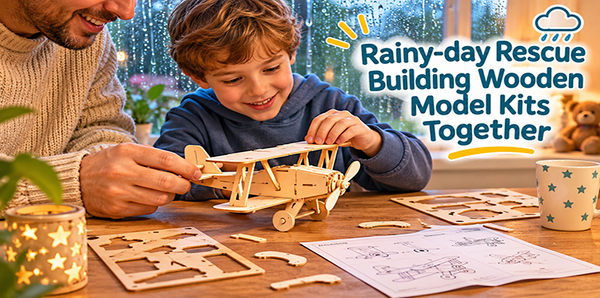
That's not a hard rule, there are brilliant open-ended plastic toys and dull wooden ones, but as a tendency it holds. If you notice your child's toys all seem to perform for them, adding a few that do nothing until the child acts is a useful corrective. A build-it-yourself wooden kit is a nice example: the toy doesn't entertain the child, the child makes the toy.
The environmental question, honestly
Wood is a renewable material and, at the end of its life, a plain untreated wooden toy biodegrades or can be recycled far more easily than mixed plastics. Plastic toys, especially the battery-powered ones, are hard to recycle and tend to end up in landfill. On the face of it wood is the greener choice, and for most buyers that's a reasonable takeaway.
But be wary of feeling too virtuous. A wooden toy flown across the world, heavily varnished and wrapped in plastic packaging, isn't automatically kinder to the planet than a sturdy plastic toy that lasts twenty years and gets passed to three children. The greenest toy is usually the one that gets used for years and then handed on, whatever it's made of. Buy less, buy things that last, and pass them on; that does more than the material alone.
Safety
Both wood and plastic can be made safely, and both can be made badly. With wood, look for smooth edges and non-toxic finishes. With plastic, look for the age rating and reputable testing. The one consistent wooden-toy caution is small parts: press-out model kits and wooden puzzles have small pieces and aren't suitable for babies or toddlers who still mouth things. The Georgie Porgy wooden puzzles suit children from around four or five and up for that reason. Always check the age guidance on any toy, in either material, and match it to your child.
Cost
The assumption is that wood costs more, and at the premium end it does. But it isn't a given. The Georgie Porgy wooden model kits run from £6.49 to £7.99, which is squarely in pocket-money and party-bag territory, cheaper than a lot of the licensed plastic toys children clamour for. Where wood costs more is usually in big items like furniture-grade toys and play kitchens. For small toys and craft kits, the price gap is often tiny or nonexistent, so cost isn't a strong reason to skip wood at that end.
So which should you buy?
A sensible approach for most families isn't to pick a side. It's a mix, chosen on purpose. Use plastic where it does something wood can't: ride-on toys, bath toys, anything with electronics a child genuinely loves. Use wood to add the quieter, open-ended, hands-on, durable stuff that cheap plastic often lacks: blocks, models, puzzles, craft. If your home has drifted heavily plastic, which most do, a few wooden kits are an easy rebalance without a dogmatic overhaul.
And think in terms of what lasts and gets handed on, rather than the material badge. A wooden model your child builds, names and keeps on a shelf for years has earned its place. So has a plastic toy that survives three children. The waste is the toy, of either kind, that's forgotten in a fortnight.
If you want to add some wood to the mix, the Georgie Porgy 3D wooden puzzle range is an affordable place to start, and the full toy collection and the Amazon store have more.
Frequently asked questions
Are wooden toys better than plastic toys? Not across the board. Wood tends to be more durable than cheap plastic, more open-ended, more pleasant to handle and easier to recycle. Plastic wins for electronics, bright colour and some rough-and-tumble uses. A mix of both, chosen deliberately, suits most families.
Are wooden toys more environmentally friendly? Usually, because wood is renewable and biodegrades more easily than mixed plastics. But a long-lasting toy that gets handed down is the greener choice whatever it's made of, so durability matters as much as material.
Are wooden toys safe for babies? Plain, smooth wooden toys with non-toxic finishes can be fine for babies, but press-out model kits and wooden puzzles have small parts and are not suitable for under-threes. Always follow the age rating on the specific toy.
Do wooden toys cost more than plastic? At the premium end, yes. But small wooden items like model kits can be very affordable, often cheaper than licensed plastic toys. Georgie Porgy wooden puzzles start at £6.49.
What wooden toys are good for a 5-year-old? Simple press-out model kits are a good fit. Start with a low-piece animal like a wooden bee, then move up to dinosaurs, unicorns and vehicles as their patience grows.
In short
Stop thinking wood versus plastic and start thinking about what each toy is for and how long it'll last. Add wood where your shelves are short on the quiet, hands-on, build-it-yourself stuff, and you don't have to spend much to do it. Browse the affordable wooden kits if that's the gap in your house.